Ballasting/Underlay
This section is dedicated to the methods used to imitate ballast. These
methods include both granular ballast usually made from finely crushed natural or
imitation rock and underlay rolls that have many forms including foam, granular
ballast covered foam and scenic rolls with a ballast surface. Granular methods
are usually referred to as ballast whereas sheet or rolls are usually referred
to as underlay. Granular methods are more successful when a cork or dense
foam sheet or strip underlay is used as a cover material over the timber
baseboard surface to act as a sound damper and to raise the track off the
baseboard to give the ballast profile.
Underlay or Ballast?
Underlay is a more simple method of representing ballast that allows the enthusiast to alter their track plan without damage to the track.
Ballast is a permanent more realistic method of fixing the track to the board
bonding the ballast to the baseboard or sheet underlay (cork or foam).
Ballasting should only be used when working to a track plan as once the ballast
has dried the track cannot be lifted without damage.
Ballast Underlays
Ballast Underlay is a quick method to visually represent ballast and include
foam rolls and scatter material sheet ballast. The most popular foam underlay is
manufactured by Peco where a range of profiles for the Peco range of OO and N
gauge Setrack and Streamline turnouts and crossings is available. Hornby offer a
similar product as an underlay roll but turnout profiles are not available, only
flat foam sheets. The foam
underlay is usually stuck to the track using UHU or similar adhesives but not
stuck to the baseboard. A track pin is then used to fix the track and underlay
to the baseboard allowing the track plan to be altered without damage to the
track or underlay. Foam underlay degrades with time and is not suitable for use
on long term projects.
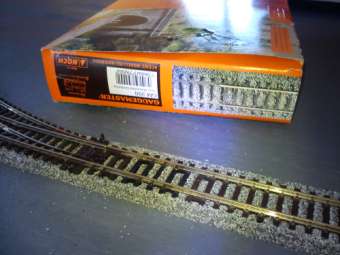
Gaugemaster and other manufactures produce a foam roll
underlay that has a granular ballast adhered to it making it more realistic than
foam ballast and helps to protect the foam from degrading. This underlay however
is not available in profiles manufactured to the shape of turnouts and crossings
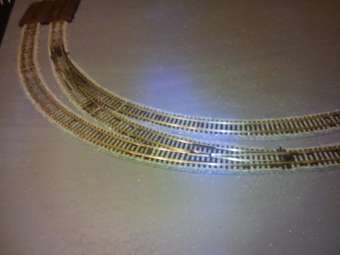
and therefore requires cutting to shape accordingly. If time is taken to
install the ballast underlay carefully a good finish can be achieved as shown in
the images below.
Ballast
Ballasting is a skill that requires great patience as care must be taken to
prevent poor running and damage to the track. A neat finish requires many hours
of dedication returning to the ballasted area several times as the adhesive
dries to ensure a tidy finish. Airbrushing a general grime over the ballast
improves its appearance, emphasising areas where grime would accumulate, or
where oil
would be deposited from standing locomotives. Never use just one ballast colour as this
tends to look poor on a layout, try and blend a few colours if possible or buy a
mix e.g. Woodland Scenics Grey Blend. Be
careful of the cheaper granite ballasts, they tend to 'green' once adhesive is
used. Use a quality ballast e.g. Woodland Scenics for improved grain size (fine
for N gauge, medium for H0/00 and coarse for 0) and excellent colour stability.
A good quality sheet or strip underlay should be used beneath the track to
act as a sound damper and to visually represent the ballast profile. The most
appropriate materials for this purpose are sheet cork or dense foam.
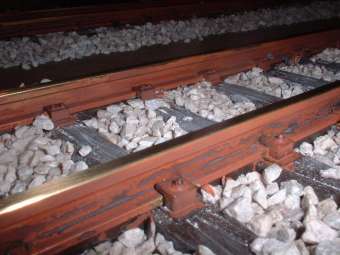
Once ballasted the appearance of your layout can be improved by weathering your
track and ballast as shown in the image below. Please see our TRACK
& BALLAST WEATHERING section for more information.
It is usually a good idea to complete your platforms before you finish
ballasting to allow a neat finish. For some useful tips on platform construction
please click here PLATFORMS.
The best methods of applying ballast is to use one of the techniques below.
Always try a sample to perfect you technique.
View step by step images of ballasting using
this method.
Once the ballast is in place, lightly airbrush a track grime over the whole
ballast area with heavier applications where more dirt may accumulate as
described above. Once the grime is dry, weather the rail faces with a rust paint
and allow to try completely before cleaning.
Professional Layout Service offer a ballasting service when laying track. We
will also ballast and airbrush your existing track and rust the rail faces.